Showing posts with label greatest hits. Show all posts

March 7, 2010

NT's greatest hits, no. 25 (of 34)

And here we go…

"Venus" by Television

This album, this band—way too cool for me. The summer of 1996 was my first extended exposure to NYC, when I slept on a cracked-leather couch in a vermin-infested apartment on St. Marks Place, fending off crack dealers on my block, interning in the fabulous world of music journalism, hitting live-music hovels four, five nights a week. It was a time, I tell ya. But I wasn't remotely as cool as that makes me sound—I wasn't doing drugs, I wasn't having sex. Once a geek, always a geek.

I had heard about Television—one of the seminal bands of NYC's classic punk scene, centered at the now-defunct (and by 1996, already irrelevant) CBGB. How they were dark and arty, how you had to consider their debut album, Marquee Moon, among the greatest works of art known to mankind if you wanted to be a real New York rock & roll sophisticate. So one evening that summer, I popped into Sounds records on St. Marks between Second and Third and bought the CD (yes…) for $9.99.

I usually hate music that I'm "supposed" to like. I spent much of the late '90s fending off constant refrains about the unparalleled genius of Radiohead, which is aural NyQuil as far as I'm concerned. So I was a bit surprised how much I loved Marquee Moon, how satisfying it was in its darkness and artiness, how—yes, dammit—Tom Verlaine and Richard Lloyd were indeed mesmerizing guitar players. Cool. I was especially taken with track No. 2, "Venus." Verlaine's cracked and quavering voice, threaded through a double helix of slinky guitar. The melody was almost jaunty, but still in the shadows; cryptic imagery setting a weird NYC nighttime scene. Was I feeling low? Huh? (The answer, at the time, was yes.) This song is too cool for me.

Incidentally, I was in Paris about five years ago, and naturally visited the Louvre. At least at the time, they have the Venus de Milo situated at the end of a long corridor, so that you can see it well before you reach it, walking slowly toward it, the image of the imposing statue gradually growing larger as you draw closer. I walked this path slowly, purposefully, Television's tight musical fantasia running through my brain. Music, sculpture and architecture in perfect harmony—this is why people like art.


More of NT's greatest hits: "Dead Man's Curve," "Message in a Bottle," "Emily Kane," "Born to Run," "Shake Some Action," "Chips Ahoy!," "Radio, Radio," "Could You Be the One?," "Summer in the City," "Teenage Kicks," "Strawberry Fields Forever, " "Tunnel of Love," "I Get Around," "Local Girls," "Don't Let's Start," "Suffragette City," "See-Saw," "My Name Is Jonas," "Mr. Tambourine Man," "Reelin' in the Years," "Objects of My Affection" and "Crimson and Clover," "OK Apartment" and "Just What I Needed"

February 6, 2010

NT's greatest hits, no 24 (of 34)

It'll take the rest of my life, but it'll happen…

"Dead Man's Curve" by Jan and Dean

I am continually in amazement of this song; it is one of the weirdest tunes to ever break through to mass consciousness.


In the 1960s, Jan Berry and Dean Torrence were a couple of pot-smoking California beach bums, party buddies of the Beach Boys who just happened to possess a fair amount of musical genius. They racked up a series of fun, immaculately written pop hits in the mid-'60s: "The Little Old Lady from Pasadena," "Surf City" ("Two girls for every boy!!!"), "Drag City." In 1966, they recorded an entire album called Jan and Dean Meet Batman, which was clearly the result of doing bong hits while watching Adam West beat up Cesar Romero. A compilation album they released in the '70s featured a chart in the gatefold, listing every song and documenting who Jan and Dean were dating and what car they were driving while recording each song. On top of being the clown princes of surf rock, Jan developed a reputation as an ace West Coast record producer. They were smart and obnoxious, legendary defiers of record-biz bullshit, and a clear influence on the eventual development of punk rock.

"Dead Man's Curve" (1964) is a majestic, almost operatic story song about a drag race in Hollywood, whose destination was a famously dangerous bend in the street. The narrator is a kid recounting the incident, ticking of the names of real-life landmarks: Sunset and Vine, Schwab's Drugstore, LaBrea. The sense of impending doom is palpable, punctuated by the harmonized chant in the chorus: "Won't come back from Dead Man's Curve!" (I used to think this was "Walk on back from Dead Man's Curve!," which made me wonder why they built the street that way in the first place.)

The whole teen-tragedy genre of the '50s and '60s was weird to begin with, but this song ups the factor, with a harp-laden dissolve right in the middle of the second chorus into a spoken interlude. The narrator is now in the hospital, telling the doctor (this is worth quoting in full):

"Well, the last thing I remember, Doc, I started to swerve (minor chord)
And then I saw the Jag slide into the curve (minor chord)
I know I'll never forget that horrible sight (minor chord)
I guess I found out for myself that everyone was right (single bass drum beat)
WON'T COME BACK FROM DEAD MAN'S CUUUUURVE!!!" (sounds of cars screeching)

The big story about this song, of course, is that two years latter, Jan Berry smashed his Corvette not far from the theoretical location of Dead Man's Curve, smashing his head right through the windshield and sustaining serious brain damage. It effectively put an end to J&D's glory days, though he would recover, and the duo would tour the nostalgia circuit up until Berry died in 2004.

This song rocks, it's fun, it's interesting, it's dramatic, and it sounds amazing. Enjoy, and make sure you use your blinker.

More of NT's greatest hits: "Message in a Bottle," "Emily Kane," "Born to Run," "Shake Some Action," "Chips Ahoy!," "Radio, Radio," "Could You Be the One?," "Summer in the City," "Teenage Kicks," "Strawberry Fields Forever, " "Tunnel of Love," "I Get Around," "Local Girls," "Don't Let's Start," "Suffragette City," "See-Saw," "My Name Is Jonas," "Mr. Tambourine Man," "Reelin' in the Years," "Objects of My Affection" and "Crimson and Clover," "OK Apartment" and "Just What I Needed"

December 13, 2009

NT's greatest hits, no. 23 (of 34)

Just when you thought it was forgotten…

"Message in a Bottle" by the Police


I have a sister, three years older. Based on her musical tastes, I often speak of a subgenre of rock & roll I call "Older Sister Music." Sort of pop-goth acts, e.g., Depeche Mode, the Cure, the Smiths. Not that only older sisters are into these sounds—I love the Smiths, and the BQT's door girl Sherry—youngest of three—is a hardcore OSM fan—but these bands seem emblematic of a type of teenage girl of the '80s and '90s who seemed perpetually two to four years older than me.

Yet far and above, growing up my sister's favorite band was the Police. Not a unique choice in the early to mid-'80s, but she was particularly dedicated; she had a three-foot-diameter copy of Synchronicity hung on her bedroom wall. And while I never picked up on Depeche Mode via next-bedroom-over osmosis, I did become a pretty ardent Police fan, of which I remain (Sting solo I can take or leave, especially after his management office fired DJ GB's husband).

Like the Beatles, the Police hit a sweet spot of massive fan adulation and critical appreciation. And listening to their best work, it's kind of amazing how such creative musicianship broke through to the masses on the level it did; the first few Police records combined punk rock and exotic, far-afield rhythms in a way that no one else picked up on, at least until the past few years (Vampire Weekend and bands of that ilk seem to get it, and they do have their moments). But "Message in a Bottle," my favorite Police song, is on the more conventional side: a terse and tense new-wave rock tune, with an intensely repeating guitar figure. It's a good opportunity for the band to show off its musical chops—Stewart Copeland is justly hailed as a mind-blowing drummer, but I don't think Andy Summers and Sting ever got full credit for how adept they were at their own instruments, to which "Message in a Bottle" is strong testament. And while Sting's high and yelpy vocal style is ripe for parody, it worked perfectly for this music and subject matter, at least back then (1979 this song was released).

Speaking of which, "Message in the Bottle" shows Sting's lyrical style mutating from open expressions of isolation and self-pity ("Can't Stand Losing You" is hilariously sad) to the exotic but fairly transparent metaphors of Synchronicity. "Message in a Bottle" is particularly elegant, in that it tells the story simply and unpretentiously, with plenty of palpable emotion. At the same time, it rocks, satisfying that other major aspect of my musical interest. This song is brilliant, this band was excellent. My sister was right about some things.

More of NT's greatest hits: "Emily Kane," "Born to Run," "Shake Some Action," "Chips Ahoy!," "Radio, Radio," "Could You Be the One?," "Summer in the City," "Teenage Kicks," "Strawberry Fields Forever, " "Tunnel of Love," "I Get Around," "Local Girls," "Don't Let's Start," "Suffragette City," "See-Saw," "My Name Is Jonas," "Mr. Tambourine Man," "Reelin' in the Years," "Objects of My Affection" and "Crimson and Clover," "OK Apartment" and "Just What I Needed"

November 14, 2009

NT's greatest hits vol. 22 (of 34)

Onward!
"Emily Kane" by Art Brut


Last night, I accompanied a few members of BQT team Jefferson Davis Starship to Brooklyn Bowl, an impressive new hybrid bowling alley–music venue–restaurant in Williamsburg (and future site of a Big Quiz Thing event? Worth considering and perhaps pursuing). We were there for the gourmet French-bread pizza, of course, but mainly to see Art Brut in concert. If you're not familiar, Art Brut is a fun and unique British band; they perform lighthearted but guitar-heaving songs about adolescent topics like comic books, hooking up with girls, and—in a brilliant example of self-reference—forming a rock band. Their shtick can get old seven or eight tracks into an album, but they hit a rich vein of old-fashioned rock & roll fun far more often than most modern acts.

I first heard "Emily Kane" in 2005; it was the third single from the band's appropriately titled debut album, Bang Bang Rock & Roll. Frontman Eddie Argos—it's not really accurate to call him a singer—rambles through the story of his teenage girlfriend, named, of course, Emily Kane, with wide-eyed longing ("If memory serves, we're still on a break") and hilarious desperation ("I've not seen her in ten years…nine months…three weeks…four days…six hours…13 minutes…five seconds"). Art Brut's trademark meta-playfulness is in effect: "I hope this song finds you fame/I want schoolkids on buses singing your name."

Argo's offhanded, speak-sing style recalls the Fall, but with less arty pretension, and the whimsical nature of the whole thing puts me in mind of Jonathan Richman, but with a good deal more rock muscle; the band can really play, and they clearly have so much fun with it. But what really gets me about the song is its specificity, and believability: You have absolutely no doubt that there actually was a teenage girlfriend named Emily Kane, that he still pines after her a decade later, and that he fantasizes about how she'll react to the song. (How did she? I can't find an account online; every time I see the band in concert, some version of the tale is told, but Argos's thick accent and the band's characteristic noise haven't let me hear it very well.)

If you like this, take a listen to Art Brut's most recent album, Art Brut vs. Satan (another very indicative title), produced by the great Frank Black. Music is fun, my friends

More of NT's greatest hits: "Born to Run," "Shake Some Action," "Chips Ahoy!," "Radio, Radio," "Could You Be the One?," "Summer in the City," "Teenage Kicks," "Strawberry Fields Forever, " "Tunnel of Love," "I Get Around," "Local Girls," "Don't Let's Start," "Suffragette City," "See-Saw," "My Name Is Jonas," "Mr. Tambourine Man," "Reelin' in the Years," "Objects of My Affection" and "Crimson and Clover," "OK Apartment" and "Just What I Needed"

October 23, 2009

NT's greatest hits vol. 21 (of 34)

I'd do that cutesy "It's ba-ack!" thing, but that's such a cliché, don't you think?


The sheer power of this song simply cannot be overestimated. Bruce Springsteen is one of the biggest rock stars of all time, and that's a good thing. Although I am a fan, I'm not a hyper-Bruce partisan (haven't once seen him in concert), but I think he better than anyone embodies the sense of hugeness, freedom and epic excitement that rock & roll is supposedly all about, but too often isn't. There's a purity to Springsteen, no matter how rich and famous he gets, and even when his songs are more boring than dirt, I appreciate that it's real, honest, American dirt.

"Born to Run" is not boring as dirt. It's unquestionably his best song, probably one of the best songs by anyone ever. It's just such a bracingly pure expression of what everyone must feel during some dark night of the American soul or something. By 1975, when it was released, Springsteen was maturing, looking back on the endless hardscrabble streets of his New Jersey upbringing, the epic nights of possibility and adventure, and he was seeing the bitter undercurrent. "Born to Run" is hardly a bitter song (unlike "Born in the USA"—you hear me, dumb-ass politicians?), there's some resilient optimism, but he drenches it in the desperation and neglect of a man who's starting to see his runaway American Dream for what it truly is: a death trap, a suicide rap. He's begging—absolutely begging—Wendy to let him in, he wants to be her friend, he wants to guard her dreams and visions. He swears, they'll run till they drop, baby, they'll never go back (altogether now)—WO-O-OH!

I like to karaoke to this song, but it takes a whole lot out of me; for a tune like this, you either bring it hardcore of you don't bring it at all (I once knocked over a bass drum during the instrumental solo; another time, I broke the microphone before the vocals even began). Better yet, sing along to it while you're driving, and make sure you learn all the lyrics first. Trust me, it's worth it.

More of NT's greatest hits: "Shake Some Action," "Chips Ahoy!," "Radio, Radio," "Could You Be the One?," "Summer in the City," "Teenage Kicks," "Strawberry Fields Forever, " "Tunnel of Love," "I Get Around," "Local Girls," "Don't Let's Start," "Suffragette City," "See-Saw," "My Name Is Jonas," "Mr. Tambourine Man," "Reelin' in the Years," "Objects of My Affection" and "Crimson and Clover," "OK Apartment" and "Just What I Needed"

September 22, 2009

NT's greatest hits, vol. 20 (of 34)

And we're off!

"Shake Some Action" by the Flamin' Groovies

Several years ago, someone asked me if, typically, I'm more attracted to a song for its lyrics or for its music. My knee-jerk answer was lyrics, but after a microsecond of reflection, I realized that I was completely self-deluded. Just taking a look at my list of favorite songs shatters this theory: I have no idea what half of these tunes' lyrics are about.

This entry underlines the point, not only because I never much paid attention the the lyrics of "Shake Some Action" (there's not much to pay attention to, other than the kicky title), but because a song like this is so thoroughly a creature of its instrumentation and production. The Flamin' Groovies were a greasy, blues-soaked rock & roll band, emerging in late-'60s San Francisco just when their sound became the least hip thing in the universe (read: they were nothing like the Grateful Dead). Truth be told, I don't care for much of their output from this era, but they soldiered on until 1976, when Welsh pub-rock genius Dave Edmunds produced their album Shake Some Action, an unlikely hit among the emerging elite of British power pop.

This title track is easily the Flamin' Groovies' best-known song (it's appeared on a couple million power-pop compilations, and Cracker covered it in the film Clueless), a remarkably canny synthesis of raggedly, lo-fi performance and soaring hooks. Both the chiming guitar (yes, there's the Byrds, again) and the intensely untrained vocals have a muted tone, working together perfectly to lull the listener in. And atypically for the power-pop genre, typified by punchy rock nuggets, the Groovies spread out over four and a half minutes, constructing an almost hermetic, wistful pop nirvana. It completely doesn't matter what the lyrical content is; the pure sound of this song has an almost neurological effect on me.

I am heartbroken that I cannot find the original recording on the Web to share with you here. The best I can do is this, a passable live version, but nowhere near the primary document. Or check out my man John Davis's radio show, 1-2-3-4 More More More, and scroll down to the 9/12 show (only there for a limited time); he starts the broadcast with the real thing.

Of course, you can get it from iTunes, and you really should. You need to hear my favorite moment: At 2:14, when the one of the vocalist goes, "Whoo!" He knows what I'm talking about.

More of NT's greatest hits:
"Chips Ahoy!," "Radio, Radio," "Could You Be the One?," "Summer in the City," "Teenage Kicks," "Strawberry Fields Forever, " "Tunnel of Love," "I Get Around," "Local Girls," "Don't Let's Start," "Suffragette City," "See-Saw," "My Name Is Jonas," "Mr. Tambourine Man," "Reelin' in the Years," "Objects of My Affection" and "Crimson and Clover," "OK Apartment" and "Just What I Needed"

September 11, 2009

NT's greatest hits, vol. 19 (of 34)

Bingo!

"Chips Ahoy!" by the Hold Steady

I gotta be honest, as much as I like the Hold Steady, they are one of those bands for whom I have less patience than I should. They are such a critics' band; the kind of act that cognoscenti cream themselves over, disproportionate to their popularity in the real world, mostly because they tend to remind critics of themselves, or at least their rock-star fantasies of themselves. Yes, this is impatience is partly because I used to be an aspiring member of that same elite, with the same fantasies, and I just grew weary on the whole masturbatory business ("A profile of Thurston Moore again?"). Nonetheless, I really do dig the Hold Steady, unlike some other critical darlings whose appeal has always mystified me (I have never gotten, say, Pavement, much to DJ GB's chagrin).

For those of you who were not college-radio DJs: The Hold Steady is a pretty straight-down-the-middle, anthemic rock band from Brooklyn, fronted by a sort of hipster-rock Bruce Springsteen character named Craig Finn (I mean, he's holding a beer in that photo, for God's sake). His songs are very literary, full of monster-sized hooks, yearning, hope, a desperately quavering voice, all that good stuff, which really is a very important part of rock & roll, if you ask me (and you're here, so you sort of did). Finn grew up in the Minneapolis area, and his songs frequently refer to the Twin Cities and thereabouts, striking a nostalgic chord with my college years.

"Chips Ahoy!" is the second track on Boys and Girls in America, the Hold Steady's 2006 album, which will make your fucking heart burst, it's so wonderfully sad. The narrator of this tune sings about his girlfriend, whose apparent psychic abilities enable her to clean up at the racetrack (Chips Ahoy! in this scenario is a horse); this segues into a lament of how their relationship is poisoned by a lack of communication and connection. "How am I supposed to know that you're high if you won't let me touch you?" the chorus goes. "How am I supposed to know that you're high if you won't even dance?" A plaintive pattern of "Woah-ho-oh-oh" backs him up, and the bridge has an extremely interesting couplet, which I've adapted more than once into my Facebook status: "She's hard on the heart and she's soft to the touch./She gets migraine headaches when she does it too much." And dig that instrumental interlude; these guys can play, yes sir. Here's a great and crazy live version:

Great video, too; sad and funny…


More of NT's greatest hits:
"Radio, Radio," "Could You Be the One?," "Summer in the City," "Teenage Kicks," "Strawberry Fields Forever, " "Tunnel of Love," "I Get Around," "Local Girls," "Don't Let's Start," "Suffragette City," "See-Saw," "My Name Is Jonas," "Mr. Tambourine Man," "Reelin' in the Years," "Objects of My Affection" and "Crimson and Clover," "OK Apartment" and "Just What I Needed"

August 20, 2009

NT's greatest hits, No. 18 (of 34)

These gaps must stop!


"Radio, Radio" by Elvis Costello and the Attractions

In late 1989, I was watching the Saturday Night Live 15th-anniversary (wow) special on TV, which featured a montage of brief clips of the show's musical guests. Included was a few seconds from Elvis Costello and the Attractions' 1977 performance. Watch:


Apparently, the band was a last-minute replacement for the Sex Pistols, were pretty much unprepared and in a foul mood, and resented being asked to play "Less than Zero," an older single that they regarded as too Anglocentric for American TV. So 20 seconds in, just to take the piss, Elvis broke it off and directed his band to start in on "Radio, Radio."

The clip on the SNL special was a mere 25 seconds long; it cut off just a few notes into the keyboard intro of "Radio, Radio." I had no idea what the rest of the song sounded like. But I was hooked. That synthesizer riff was the greatest thing I'd ever heard. Soon after, I'd purchased the then-current edition of Costello's greatest hits (the first of many), and played the song over and over again. I still remember: track No. 8, three minutes and six seconds.

Shortly after, I made my first mixtape in a long and nerdily detailed series, and "Radio, Radio" was track one, side one. In college, I had a regular tradition of hosting an all–Elvis Costello radio show during "Dead Days"—the several days of downtime between classes and finals. I always felt like Costello's cynicism and anger perfectly suited the campus mood of the time. The show always ended with "Radio, Radio." It's such a wonderful song: tense but perceptive, hard rocking but full of so many different great sounds. And that keyboard riff: A friend once told me he dislikes it because it's "too raga," but I like color, I like a little ostentation, and no one did it better than the Attractions' keyboardist, Steve Nieve. (As great a songwriter as Costello is, never discount the importance or talent of Nieve, Bruce Thomas and Pete Thomas; best new-wave band ever.)

I used to be absolutely obsessed with Elvis Costello, but the fandom has faded a little. Like so many others, I'm not enamored of his more recent material—personally, I feel like become a rich and worshipped rock star has made Costello lose touch somewhat with his muse (how can you be the angry young outside when you're nailing a beautiful Canadian easy-listening star and having your ass kissed by Burt Bacharach?). But also, I realize how cliché it was for me to be such a big fan. (A contrarian once said that rock critics like Elvis Costello only because he looks like them; while I am neither a rock critic nor a glasses wearer, point taken.) His older music, though, has lost none of its luster, its energy and perceptiveness looking and sounding better by day. Such a lot of fools are still trying to anesthetize the way that we feel, after all.

August 1, 2009

NT's greatest hits, No. 17—an amendment


The great thing about my "greatest hits" blog series is that it forces me revisit those songs that are ingrained in my psyche. Tasked with writing about them, I listen from a fresh angle, and develop an even greater appreciation for them (usually—one entry on the list was cut after I relistened to it and realized it doesn't quite deserve the honor. Still Peter Gabriel's best song, though, and still an awesome video).

So last week, when I wrote about "Could You Be the One?" by Hüsker Dü, it got me going back to the entire catalog from the band, and reaffirming my blogged conviction that it was perhaps the best American rock group of the mid-'80s. And I maintain that "Could You Be the One?" is their finest hour, but I must retract this quote: "I still think Warehouse is Hüsker's best album."

Wrong: 1985's Flip Your Wig, I've come to realize, is a nearly perfect piece of hard-rock crafstmanship. Straightforward yet experimental, bracingly angry yet tender and touching—three wasted-looking guys smashing out brilliant music, making it look easy. This is the essence of genius. Flip Your Wig was also Hüsker Dü's last album for indie label SST, before they were scooped up by Warner Bros., where they recorded the middling Candy Apple Grey, and then bowed out with the excellent Warehouse (now my second favorite of their albums). Thus it represents a band on the verge, at that tense moment of asking themselves if they'll stay true to what inspired them in the first place. The songs ping-pong between introspection ("Makes No Sense at All," possibly the closest thing the band ever had to a hit, deservedly so), rage ("Divide and Conquer," the Byrds as nihilists—clever), and even straightforward sentiment ("Green Eyes," the best punk love song ever), packed with effervescent passion, and you can feel the growing tension between songwriters Bob Mould and Grant Hart. Thankfully, they never sold out or watered down on the major label, but perhaps that cost them the future of their band.

But seriously, listen to Flip Your Wig; some great benefactor to mankind has uploaded most of the Hüsker catalog to the Web, so if you click on the image at top, you can listen to the first quarter of the album (go to Songza for the rest).

Just wanted to set the record straight. Some fresh musical commentary soon…

July 19, 2009

NT's greatest hits, No. 17 (of 34)

More, more, more…

"Could You Be the One?" by Husker Du

I wasn't really into music at all until I was 13, when I discovered classic rock. I've written before about how I developed a knee-jerk disdain for most new rock & roll being made at the time, but in hindsight, this was mostly due to the fact that I had no idea what was going on in the rock underground. Scratch that—I didn't know what was going on anywhere but classic-rock radio.

An exception was Hüsker Dü, the pride of the Twin Cities postpunk scene, who came to my attention when I was 16 and never left it. I saw "Could You Be the One?" on MTV's 120 Minutes, which is appropriate, since I imagine 99% of "alt" music discoveries among people of my generation were made through this show. The video:


The headlong melody of this song, the palpable desperation of the lyrics—a seamless combination that hooked me instantly. I went out and bought the nearly perfect album Warehouse: Songs and Stories (which, I later learned, was the last record by the band, since broken up) and played it till my crappy Walkman ate the tape. I was edging into the alt scene, slowly, and part of what attracted me to Hüsker Dü was its inate understanding of the transcendence of classic rock & roll. It's no coincidence that around the same time, I was developing a passion for The Byrds; at its best, Hüsker was essentially a faster and louder reconfiguring of the Byrds' hook and jangle. (Similarly, I would later fall in love with the Buzzcocks, who did a similar trick with the Beatles' template.)

BTW, I still think Warehouse is Hüsker's best album, which is an unusual opinion, I know; I really don't care for most of the band's early, more hardcore material—no, Zen Arcade never did it for me— and I think Bob Mould needed more time to flower into a class-A songwriter. But by the time the band got to Flip Your Wig, they might have been the best rock band in America. No small honor, even in the mid-1980s.

More of NT's greatest hits:
"Summer in the City," "Teenage Kicks," "Strawberry Fields Forever, " "Tunnel of Love," "I Get Around," "Local Girls," "Don't Let's Start," "Suffragette City," "See-Saw," "My Name Is Jonas," "Mr. Tambourine Man," "Reelin' in the Years," "Objects of My Affection" and "Crimson and Clover," "OK Apartment" and "Just What I Needed"

July 12, 2009

NT's greatest hits, No. 16 (of 34)

Very, very intermittent blogging these days. Summer is the busy season for the BQT, and whaddaya know? The miserable economy hasn't put a dent in things. Thanks for wasting your hard-earned dollars on me. And speaking of summer, this entry in my favorite-songs series is…

"Summer in the City" by the Lovin' Spoonful


Most people know this song by sheer cultural osmosis, but the Lovin' Spoonful is an unjustly forgotten band in pop-music history. Especially New York pop music, because these guys were pure creatures of the 1960s NYC Greenwich Village counterculture scene, coffeehouse hippies who made good. Armed with sunny but not annoying dispostion, a good amount of genuine musical talent and a great sense of humor (the band's name is a reference to oral sex), the Spoonful racked up a lot of hits in the '60s, most of which never get old: "Daydream," "Do You Believe in Magic?," "Pow!" and a lot others you probably don't know or forgot. Before the warm season is out, do yourself a favor: Buy/download a compilation of these guys' hits and listen to it on your fire escape on a weekend afternoon.

"Summer in the City" was their biggest hit, their best song, and a bit of an anomaly in the catalog, since it has a far sharper edge than most of their other hits. I've written before about the "tension-release" song structure, bottled-up verses exploding into expansive choruses, and this might be the best example of them all; Spoonful frontman John Sebastian once described the song's chorus as "falling off a cliff."

And what evocative lyrics to fall off a cliff to. The verses believably establish the heat, grime and claustrophobia of the NYC streets in midday July, and then the chorus welcomes in the eternal optimism of a carefree summer's night, full of romance and celebration. Meanwhile, the song is just packed with great hooks: The brilliantly simple piano riff (Stevie Wonder has called it a major influence) and the rare dignified use of ambient sound effects (gotta love the jackhammer). My only major critique: I wish they'd come up with fresh lyrics for the third verse—I want to hear more about this world. Correction: I know all about this world, but I want to hear more of the Lovin' Spoonful's musical exploration of it.

More of NT's greatest hits:
"Teenage Kicks," "Strawberry Fields Forever, " "Tunnel of Love," "I Get Around," "Local Girls," "Don't Let's Start," "Suffragette City," "See-Saw," "My Name Is Jonas," "Mr. Tambourine Man," "Reelin' in the Years," "Objects of My Affection" and "Crimson and Clover," "OK Apartment" and "Just What I Needed"

June 24, 2009

NT's greatest hits, No. 15 (of 34)

More rock & roll!


"Teenage Kicks" by the Undertones


Amazingly, this is the best copy of this song I can find online. But even if it's new to you, it is indeed a classic, easily one of the most beloved pop songs in British history. I own two completely separate compilations of classic British punk that are both titled Teenage Kicks, so that should tell you something.

The Undertones were a young Irish pop-punk band that did pretty well in the U.K. in the late '70s—"My Perfect Cousin" and "Here Comes the Summer" are nearly as excellent—peaking with this 1978 single, a basic but insistent declaration of pep and hormones. "A teenage dream's so hard to beat/Every time she walks down the street" has a kind of savant genius to it. Famously, the single was picked up by John Peel, a tremendously influential DJ of the era, who awarded it 28 stars on his five-star scale, played it nonstop, declared it his favorite tune of all time, and now has a line from it inscribed on his tombstone. Dedication.

I wouldn't go quite that far—the song doesn't exactly have a lot of texture, and I don't have that much adolescent nostalgia—but you can't beat "Teenage Kicks" for a straight-between-the-eyes rock song. That riff will absolutely never get old, and you can feel the band's genuine youthful anxiety—lead singer Feargal Sharkey was only 20 at the time, guitarist and songwriter John O'Neil was 21—oozing through every note.

As a bonus, my lady friend turned me on to this: a cover version by Nouvelle Vague, a French band that covers new wave, punk and postpunk as bossa nova tunes (making their name an exceedingly clever pun). I love the way she enunciates "right through the night"…


More of NT's greatest hits:
"Strawberry Fields Forever"
"Tunnel of Love"
"I Get Around"
"Local Girls"
"Don't Let's Start"
"Suffragette City"
"See-Saw"
"My Name Is Jonas"
"Mr. Tambourine Man"
"Reelin' in the Years"
"Objects of My Affection" and "Crimson and Clover"
"OK Apartment" and "Just What I Needed"

June 14, 2009

NT's greatest hits, No. 14 (of 34)

Back again, continuing the series of posts about your quizmaster's favorite songs…"Strawberry Fields Forever" by the Beatles

Want to get a quick, superficial idea of someone's personality? Ask them these three questions:
1. What's your favorite flavor of ice cream?
2. Whom do you identify with more: Superman or Batman?
3. What's your favorite Beatles song?

All can be determined from an individuals answers. Mine are (1) mint chocolate chip; (2) Batman (I'm a little dark); (3) "Strawberry Fields Forever." There, now you know me. You can stop reading this blog now.

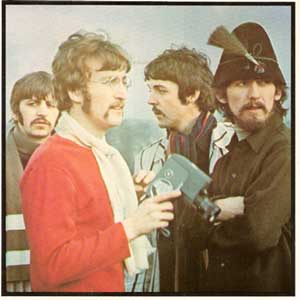
One of the things that made the Beatles so very, very great—the best rock band ever, an unbiased observer has to admit—was how they fully embraced the "experimental" side of rock music, during its first mainstream flowering, without losing sight of the melodies, rhythm and colorful lyrics that make so much rock & roll so much fun. "Strawberry Fields Forever" is a hella weird song—the title refers to a mental institution—but the playful, lilting tune can keep any listener engaged. As I've mentioned many times in this series, I love the weird, so long as the weird is in service to something that can enjoyed without the use of a slide rule and a Nietzche text.

I think of rock acts that spiraled too far down the weirdness road—Captain Beefheart is a handy icon of that. Interesting, sure, but I can't feel any of that in my soul. On the other end of the spectrum, take the Rolling Stones, whom I've loved at various points, but who have spent way too much of their career flogging the same decomposed blues-rock-decadence horse. The Beatles found the sweet spot in the center, and applied a ridiculous amount of talent to creating something of value in that place. Many things of value; "Strawberry Fields" may be my favorite Beatles song, but there's a long and lovely list of runners-up.

And yes, check out the creepy musical reprise at the end of "Strawberry Fields." Used to scare the crap out of me, especially the "Cranberry sauce"/"I buried Paul part" at the end. In my more susceptible moments, I still wonder if Paul really is dead, if Billy Shears formed Wings, and if the Beatles were really Satanic lunatics bent on destroying the youth of the Western world. Those are the days I should really leave the apartment more.

May 17, 2009

NT's greatest hits, No. 13 (of 34)

Wow, can't believe how long it's been. Another of my favorites songs.
"Tunnel of Love" by Dire Straits


DJ GB once said something interesting: You can see how much the music industry has changed in the past 25 years by looking at Dire Straits. In the mid-'80s, for a time, this band of balding, over-the-hill pasty white guys was the biggest-selling musical act in the world. Granted, they benefited from a gimmicky video, but based on their physical appearance, it just wouldn't happen today. They wanted their MTV, by gum, they got it. Careful what you wish for.

But that's irrelevant when considering the quality of Dire Straits' music, which has often been very high. Mark Knopfler is celebrated as an excellent guitarist, and he is, but at least in his band's early days, he was a world-class songwriter as well. The band's third album, Making Movies, is a really incredible piece of work: a brief but sprawling stumble through disappointed romance, expressed through expert musicianship. Do not, I repeat, do not listen to it on a Tuesday at 4am when your ex-girlfriend hasn't responded to your Facebook message from two weeks ago.

Especially the opening track, the operatic "Tunnel of Love," which is one hell of a heartbreaker. It's basically eight minutes of an amusement park metaphor for easy love and its regretful aftermath—he's "searching through these carousels and carnival arcades/Searching everywhere from Steeplechase to Palisades." For this narrator, love (actually, I think the intention is just sex) is an afternoon on the Waltzer, at the shooting gallery, under the big wheel, riding the Ghost Train. A low ride in the Tunnel of Love.

Sounds goofy, but the band pulls it off with incredible grace; Knopfler's conversational guitar nicely punctuate his plainspoken vocals, which the rhythm section keeps a chugging background groove. The song rocks for a few verses, bounds into a spirited guitar solo, then instantly but smoothly melts into an aching final third, the guitar virtually going off into a crying tantrum. A brilliant synthesis of content, mood and musicianship, and enough to make me never want to go to Coney Island on a first date.

More of NT's greatest hits:
"I Get Around"
"Local Girls"
"Don't Let's Start"
"Suffragette City"
"See-Saw"
"My Name Is Jonas"
"Mr. Tambourine Man"
"Reelin' in the Years"
"Objects of My Affection" and "Crimson and Clover"
"OK Apartment" and "Just What I Needed"
April 24, 2009

NT's greatest hits, No. 12 (of 34)

Wow, way too long since I posted one of these. I've been slow with the blogging, trying to Twitter like a good hiptard. But here it is, volume 12. Let's all sing along!

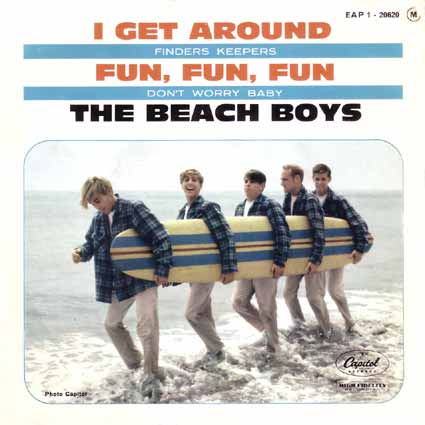
"I Get Around" by the Beach Boys

Really, truly, you have to love the Beach Boys. They are true American treasures (or were; if you have the stomach to contemplate the various entities that presently tour the country under the name "the Beach Boys," you are a stronger person than I).

But it's hard to find a more solid catalog of classic American pop than the Beach Boys' 1960s hits. They simply nailed the form—free-sailing vocals over irresistible melodies, beautifully succinct tales of life at its happiest and its saddest—while expanding the idiom into the realm of true musical genius. Granted, some of the experimentation spun out of control—I like Pet Sounds, but I really regard it as the band's last gasp of greatness. But perhaps I'm not alone; I once spoke with Brian Wilson on the phone, and he acted pleasingly shocked when I told him Pet Sounds was a great album.

But back up to 1964, when the Beach Boys scored their first number one single, "I Get Around." I love this song because it really covers several bases. Typical of the Beach Boys' genius, it melds sunny nostalgia with an invigorating collage of harmonies, overdubs, a wonderfully wacko song structure. But the kicker here is the edge: It has just the right amount of forward momentum to make it a truly killer rock tune. And lyrically, that's a great euphemism: I get around. Translation: I call the shots and I get all the tail I want.

But that brings me to an interesting point: There's an element of this song that I really dislike. This guy sounds like such a douchebag. He's boasting about what a cool badass he is, how people don't fuck with him, how great his car is, how chicks are so into him. There was something of this to a lot of the Beach Boys songs—if you didn't have the right ride and the right girl, you couldn't join the club—but this character comes dangerously close to coming off as a real phony. Nonetheless, you somehow believe him. If he were full of shit, would he be backed up by such a great and original composition? Really, it compensates for his seemingly insecure boasting. Show don't tell, I always say, and while lyrically, "I Get Around" is a lot of tell, musically it's a supreme example of show.

More of NT's greatest hits:
"Local Girls"
"Don't Let's Start"
"Suffragette City"
"See-Saw"
"My Name Is Jonas"
"Mr. Tambourine Man"
"Reelin' in the Years"
"Objects of My Affection" and "Crimson and Clover"
"OK Apartment" and "Just What I Needed"

April 10, 2009

NT's greatest hits, No. 11 (of 34)

And we're back. On tap for this volume of my favorite songs of all time: something you probably don't know, but should...
"Local Girls" by Graham Parker and the Rumour
When I was in college, I hosted a radio show (most semesters titled Noise Annoys) that focused on my favorite subgenre of rock & roll: punk and new wave of the late '70s and early '80s. All your favorites: Blondie, the Jam, the Cars, the Buzzcocks, the Ramones; I could get as arty as Roxy Music and as poppy as Men at Work.

At least from a rock geek's point of view, this is a pretty broad swathe of the rock idiom. (Go here for an especially savvy sampler.) It wasn't just punk and new wave; we also had power pop, new romantic, mod revival, ska, protopunk, the early glimmerings of electronica…and pub rock. Pub rock was a British style that sought to return the music to its basics: four or five sweaty young drunks bashing out good music for a small room of felow drunk hipsters. And the king of the pub rockers was Elvis Costell…er, Graham Parker.

Costello was the patron saint of my radio show, sure; I was obsessed with the guy in college (and my favorite of his songs will be featured in this series anon). But Parker, along with his band, the Rumour, released the single best album of the idiom—not just of the pub rock subsubgenre, but all of new wave, and perhaps all of rock music entirely: 1979's Squeezing Out Sparks. While I've since come to recognize broader differences between Costello's and Parker's music, I used to refer to Sparks as "the best Elvis Costello album ever." It's a simply blistering rock & roll album—arch, angular, exciting, dripping with both venom and self-aware humor, with hardly a weak song, and several stunningly excellent ones. And "Local Girls" is the unquestioned highlight.

Rarely has a rock recording featured a better performance. Watch and listen; this band is incredible:


Great video; that delicious charm that so many of the pre-MTV videos had, when simply playing music on camera was still a novelty. The song is a Kinksian slice of British life—Parker finds the ladies in his workaday British world to be both irresistible and tiresome, profressing his lack of interest as he subliminaly begs for their attention. The lyrics are good—"Don't bother with the local girls/They don't bother me" is a frequent refrain during my bitterest moments—but the band's performance is incredible. Curdled vocals, flawless support from the interdependent rhythm section, and that astonishing call-and-response between Brinsley Schwarz's lead guitar and Bob Andrews keyboard. All beautifully packaged as yet another "tension-release" song, with the song collapsing off the cliff as the chorus hits.

I played the shit of this song on my radio show; it so perfectly summed up what my show—what my favorite music—was all about. Angry but self-deprecating, awkward by cool, powerfully rocking but with a sense of humor. If every rock song sounded like this, I'd find this a much, much better world.

Earlier editions of NT's greatest hits:
"Don't Let's Start"
"Suffragette City"
"See-Saw"
"My Name Is Jonas"
"Mr. Tambourine Man"
"Reelin' in the Years"
"Objects of My Affection" and "Crimson and Clover"
"OK Apartment" and "Just What I Needed"
March 29, 2009

NT's greatest hits, No. 10 (of 34)

So this time, I'm dropping the idea of picking these songs from my list of all-time favorites at random. Rules are made to be broken, bitch! Here we go…

"Don't Let's Start" by They Might Be Giants
Yesterday, I was among the entertainment at a bachelor party; an hour of custom quiz as part of a day of festivities. The evening's climactic event was an outing to (Le)Poisson Rouge in the Village to see They Might Be Giants in concert, and my payment was an extra ticket to the show*. Good deal. This was not the first time I saw TMBG live—No. 7, by my rough estimate—but it was the first in probably ten years. I'm not all that into them now, but I loved the two Johns in high school and college, which is extremely unsurprising. This is a band that by all rights, has no business still having a career 25 years after they formed. Lucky for them, geeks like me have conquered the world.

My favorite They Might Be Giants song—sadly omitted from last night's playlist (and no, Katie, they didn't do "Minimum Wage" either)—is "Don't Let Start," one of their first singles. I will not write another word (except these) before showing you the outstanding video:


This is another one of those videos that is perfectly attuned to its song—the rollicking interplay of guitar and keyboard, the jerky stop-start rhythm, the ridiculous randomness. I've written before about how I tend to be drawn to rock & roll with just the slightest avant-garde bent, and I think They Might Be Giants is the apotheosis of that idea: They were your typical NYC music nerds who synthesized whacked-out art music into hooky pop songs, Sonic Youth but catchier and a lot less intimidating. It's no wonder they now make their bread and butter as kid-rockers, considering that most current children's entertainment is predicated on the concept of weird for weirdness' sake.

"Don't Let's Start" was a tremendously influential song in my rock & roll development, like so many other tunes on this list. I first saw this video—first heard of the band—in January 1988, when I saw it as part of a Dr. Demento–hosted MTV countdown of "The Most Demented Videos of All Time." (No. 1 was this, which seems about right.) This was one of the initial things that clued me in to the existence of pop music out of the mainstream, a richer, more intriguing, and just plain smarter world of rock & roll beyond the pabulum pumped out by bar mitzvah DJs. Eight months later I discovered classic rock and developed a rock snob disdain for nearly anything made after 1979, but I always kept a place in my heart—for much of high school, the most honored place—for They Might Be Giants, who always seemed to have something fascinating and fun to offer.

Who's doing that now? Fascinating, okay—lots of rock bands now are continually trying new things. But very few are remotely as fun as TMBG was in its heyday.

*This is what we in the trivia business refer to as a lie, or at least a grossly misleading statement. I was indeed paid money for the trivia event; the concert was an excellent bonus. Moreover, the party had an in with the venue, so it didn't cost them anything to add my name to the list. But it sounds more interesting this way.

Earlier editions of NT's greatest hits:
"Suffragette City"
"See-Saw"
"My Name Is Jonas"
"Mr. Tambourine Man"
"Reelin' in the Years"
"Objects of My Affection" and "Crimson and Clover"
"OK Apartment" and "Just What I Needed"

March 20, 2009

NT's greatest hits, No. 9 (of 34)

I'm changing the numbering scheme of these posts; easier for me to keep track. Nutshell: These are my favorite songs ever, from both genres: rock and roll.

"Suffragette City" by David Bowie
I first heard this song, oh, 1988, 1989, on New York's WNEW-FM, which was the original, and probably all-time best, "classic rock" radio station (I actually interned there for a summer in the 1990s, around the time it was falling apart). More than any other single media entity, this station established my musical taste, providing nearly 100 percent of my daily allowance of rock during my musical-fan formative years (ages 13–15, roughly). It was a great station at the time, playing the unassailable classics of the mainstream rock genre—both hits and deep cuts by the Stones, the Who, the Beatles, etc.—along with a fairly smart assortment of present-day rock; you could always count on it for hearing whatever the new release was by, say, Elvis Costello or XTC.

Now, Elvis Costello and XTC weren't exactly ground zero for "present day" when we're speaking about the late 1980s, but I think that indicates just how unmoored mainstream rock was at the time, and that affected my tastes. I grew to feel that almost anything "new" at the time was sheer crap (hair metal being an iconic genre of that assortment); the classic was inherently better. Apart from making me a snob, this conception blinded me to the excellent rock & roll that was being made, primarily in the underground. If only WNEW hadn't existed and I'd instead discovered WFMU or something, I might have become the teenage punk I often think I was destined to be.

Okay, I'm way off topic here. The point is, limited though my tastes may have been, they were good, and WNEW was a big reason. For example, it gave David Bowie a lot of love, and "Suffragette City" sucked me in the moment I first heard it. It's ridiculously exciting, and the climax of what is his most successful rock album (full title, get ready): The Rise and Fall of Ziggy Stardust and the Spiders from Mars. A rock "opera" that eschews about 85 percent of coherent plot for sound and style.

"Suffragette City" is a prime example; I didn't even know what the word suffragette meant until several years after I discovered the song, and when you pick the lyrics apart, it's basically a glam-rock version of a frat jock bragging about getting laid. But I feel as if it's a tune whose lyrics were chosen for their sound rather than their meaning. Bowie spins off some great turns of phrase here: this mellow-thighed chick just put my spine out of place, droogie don't crash here, and of course, Wham! Bam! Thank you, ma'am. Combined with positively thrilling music—the false ending is great, the call-and-response Hey, man!s are awesome—these lyrics make this one of the flat-out coolest songs I know. Style in the service of substance; this is what put David Bowie in the rock pantheon, and incidentally what put his music on a radio station like WNEW.

Summer 1990, as a regular at my camp radio station, I unilaterally gave myself a "license to overplay" "Suffragette City." One of the best decisions I ever made.

Earlier editions of NT's greatest hits:
"See-Saw"
"My Name Is Jonas"
"Mr. Tambourine Man"
"Reelin' in the Years"
"Objects of My Affection" and "Crimson and Clover"
"OK Apartment" and "Just What I Needed"

March 12, 2009

NT's greatest hits, vol. 6

Let the series continue. Another of my most beloved songs.

"See-Saw" by the Jam
I had some hesitation in putting this song on my list. I mean, I love it; never get sick of it. And I love the Jam. But of all the Jam's outstanding songs, I was reluctant to declare this my favorite. First of all, the lead vocal is by Bruce Foxton, the band's bassist, and not frontman-songwriter Paul Weller. Foxton has a relatively weak voice, and while this isn't the only good Jam song with him up front ("Smithers-Jones" and "News of the World" also come to mind), it feels wrong to give one of his tunes the big nod.

Moreover, "See-Saw" was originally a B-side to the great "Eton Rifles" (1979), never included on a proper album, and I don't want to be one of those pretentious snobs who says, "Oh, you like the Jam? Yeah, I guess their greatest hits is all right, but you'll never understand them unless you hear this vinyl-only Japanese import of a show they did for 45 people in the middle of a hurricane back in 1836." You know what I mean.

But last week, I heard "See-Saw" again in a new light (no comment about what I had ingested), and I realized that truly, it is this titanically talented band at its best. The steady, tension-filled opening explodes into a rollicking mod rhythm, with an exciting back-and-forth dynamic that perfectly suits the song's title. The bitterly resigned lyrics speak to me, as always, but the song reaches an exhilarating zenith in the ending. Foxton, with Weller providing earnest backing vocals, blazes through a recap of the song's salient points ("See-saw/Up and down/Around and round/They say it heals in time/They say you'll feel just fine…). And instrumentally, the song is seamless; the Jam constituted probably the tightest trio in the history of punk rock. Brilliant.

Earlier editions of NT's greatest hits:
"OK Apartment" and "Just What I Needed"
"Objects of My Affection" and "Crimson and Clover"
"Reelin' in the Years"
"Mr. Tambourine Man"
"My Name Is Jonas"

March 6, 2009

NT's greatest hits, vol. 5

We continue. The conceit: I have an iTunes playlist of my 34 favorite songs of all time, and I discuss them here, one by one, in random order. This edition…


"My Name Is Jonas" by Weezer
For a male of my age with a touch of the misfit in them, I suppose this isn't a surprising choice. Weezer's first album hit me a particularly potent time—not yet remotely a man, but couldn't possibly remain a boy—and Rivers Cuomo's intensely potent blend of rock hooks, abject sentiment, and outsider anger absolutely homed in on the tender underside of my psyche. I think that album is an absolute monument of rock & roll (eight of its ten songs are included in my ever-expanding mixtape series), and its opening track, "My Name Is Jonas," is its strongest moment.

Lyrically, I really have no idea what it means (go ahead and take a stab), but I almost feel as if that's part of the song's strength. Impressionistic, the words almost sound as if they were chosen for their sound rather than their meaning, and Cuomo spits them out with such energy that I wonder if any lyrics would have done the job. Probably not; obscure or no, there's something poignant about desperate repeating chants of "making noise!" and "the workers are going home!"

Also, it fulfills a mandate of many of my favorites: It's just a little bit experimental. The forlorn harmonica solo at the end of the raging instrumental solo and the fact that the whole song is in 6/8 time signal to anyone listening that Weezer is infinitely more interesting that the pop-punk pranksters the media framed them as in '94. (I will never understand that. During my music journalism days of the late '90s, I was laughed at—literally laughed at—for suggesting that Weezer's first record was among the top 200 best releases of the decade. Amazing.) I'm a rock purist, of course, little use for the artier genres, but I often feel a seductive pull to any rock & roll that drifts slightly into the realm of the bizarre (hence my love for Devo, although that band will not appear in this blog series). You can see that in a number of my entries so far; kind of unsurprising my favorite Steely Dan song is the one most like a standard rock tune.

A warning about "My Name Is Jonas," though; actually, a warning about all of Weezer's debut album: I find it awfully, awfully depressing. It's clear Rivers Cuomo was (is?) an awfully sad man, and like all great artists, his emotion comes through and digs into the audience. So on a melancholy Friday evening, you might want to dial up something a little more sunshiney. (Try this; a runner-up for this series.)

Next time: A new-wave classic that I played to death on my college radio show? The bombastic anthem of my high-school misanthrope stage? The soundtrack to the night of the best sex of my life? Only the random magic of iTunes can tell.

Earlier editions of NT's greatest hits:
"OK Apartment" and "Just What I Needed"
"Objects of My Affection" and "Crimson and Clover"
"Reelin' in the Years"
"Mr. Tambourine Man"