Showing posts with label cartoons. Show all posts

June 11, 2009

When worlds collide

Just wanted to pass along this great video from Slate (a favorite time-wasting site).
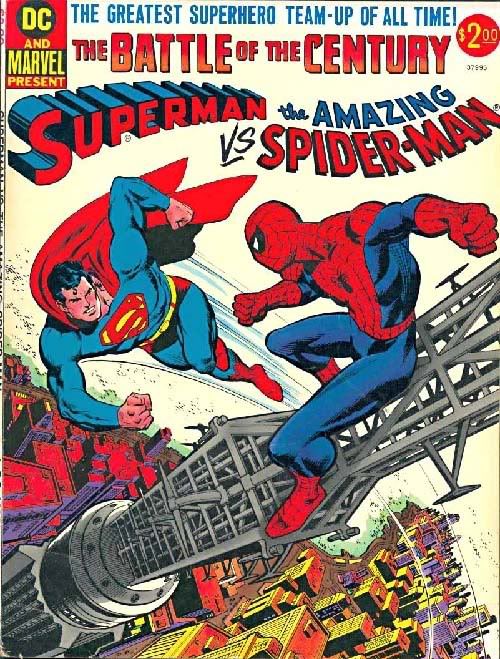

Yes, yes, it makes me want to do drugs more. But I'm more fascinated by the concept of the crossover: all the various characters owned by disparate companies teaming up for the same project, appearing together in a shared universe. I've always been of two minds about these projects. I mean, it was a thrill to witness Superman and Spider-Man clashing…
…but what are the implications? All of the DC and Marvel characters inhabit a single world? What does that mean for long-term continuity? Do the Teen Titans confront Galactus when he threatens Earth? Does the Punisher try to murder the Penguin? Is the Doom Patrol jealous of the X-Men's resources and cachet? Yes, it's just a story, but for a true comic geek, it raises too many necessary questions to answer in a single one-off publicity event.

Other times, the crossover is a neat fit, and adds a welcome richness to a series's back story. Like how it was established The Golden Girls and Empty Nest occurred in the same fictitious Miami…

(Sorry for the poor quality; a car burglar stole my Empty Nest DVD box set.) Despite the discomfiting humor here, there don't seem to be too many major reverberations to this. Blanche, Dorothy and Rose are ensconced quietly down the street. The middle-aged Floridian crises are small enough that nothing would necessarily draw the attention of unseen characters (except when it does, as in the well-handled "Hurricane Saturday" crossover event, which is woefully underdocumented on the Internet). Nice and easy.

Cartoon All-Stars to the Rescue avoids any pitfalls (or benefits), of course, since the characters coexist only in the young man's pot-addled dream mind. In fact, as Slate's commentator points out, that's a fairly realistic scenario, someone blitzed on weed and dreaming about Bugs Bunny, the Muppet Babies, and the animated version of Alf all at the same time. This is genius.

April 9, 2009

A rant, part III

…wherein I become a little less ranty. After part I and part II, lets look at a couple of New Yorker cartoons that I actually really like.

But first, to respond to two comments I've received about this extended bout of vitriol: (1) Yes, I'm sure the cartoons were in general much better in the golden age of The New Yorker, the '50s and thereabouts. Makes sense. All the more reason why the magazine should go the extra mile to hire worthy talent today. (2) Of course many of the cartoons lack timeliness because they were drawn months earlier; I know all about evergreen features and articles in the magazine business. But something about Bernie Madoff, or any newsworthy figure, necessarily has a timeliness element to it. If Roz Chast can't draw it when the topic is still a fresh one—or The New Yorker can't run it—then it should be killed.

Now, then, onto goodness. I love these cartoons:
The basis of most humor is the conflict between expectation and reality (which is why the best way to make a baby laugh is to surprise him), and this cartoon is a pretty stark example: That comically over-the-top stereotypical prison goon is this guy's mom. If the word "Mom" were instead "Dad," or "Phil," there'd be no joke here, of course (or at least not a good one). "Susan" or another female name would be okay, by "Mom" nails it. Clever enough, but what really makes me laugh is the drawing. Not just the boilerplate-scary ex-con, but the blandly cheery look on the driver's face. He doesn't look scared or concerned that his mother has turned into Mr. Zsasz; he seems to just be making friendly, typically parent-pleasing conversation. This really works.I have a little more trouble putting my finger on why I like this one so much. First of all, I think it's extremely well drawn; this writer has a terrific, clean yet light style that's perfect for the dry wit that suits New Yorker cartoons best. Also, and maybe this doesn't say anything good about me, but I find inherent humor in hosptials: the surgical masks, the gas tanks, the prone woman on the table; I like dark comedy. Plus, "Feldman" is just a funny name (sorry, chief). Finally, I suppose it's just the clever juxtaposition of surgery and getting lost on the road that this artist synthesizes so skillfully. Another example of what every cartoon in The New Yorker should be like. Perhaps, maybe, someday: I will continue to dream.

April 5, 2009

A rant, part I

If you know me well, you know that I'm a bit of a complainer. Thankfully, though, I've kept most of the vitriol out of this blog. But tonight, let's taste a little, shall we? Allow me to rant about one of my pet peeves: the cartoons in The New Yorker.

I love The New Yorker; one of the few magazines I read, and the only one I maintain a subscription to (if you don't count my college alumni magazine, and you shouldn't). But I love it for the articles. The pictures, not so much. I have a standing dislike for The New Yorker's famed cartoons: For the most part, they're not funny, they're not particularly well drawn, and they're obnoxiously elitist.

This week is the prime moment to discuss this, because the current issue's cover features work by my least favorite of the regular cartoon contributors, Roz Chast:
Roz Chast makes a career of rehashing the clichéd foibles of modern New York life: everyone's neurotic, men are different than women, cats are lazy, old people can't deal with technology. If there's a hackneyed observation about modern life, she's on the case, with no fresh insight, minimal imagination, and a cartooning style that—while charming—evinces very little originality.

Ironically, this cover is among her best work; it actually made me smile—some clever ideas here, for a change—until I got to the end and saw it was a riff on the Bernie Madoff debacle. So she's at least a few weeks behind the relevance curve (her own magazine published what I consider the authoritative article on the subject two weeks earlier). This highlights Roz Chast's greatest sin, and the greatest sin of many of The New Yorker's cartoonists: She's lazy. She couldn't be bothered to strike when the iron is hot (which is vital, if your goal is topical humor), failing as the cultural commentator that she and many of the other cartoonists apparently are supposed to be.

Many disagree. A few months ago, Slate published an article by someone who'd won The New Yorker's cartoon caption contest, explaining his secrets for victory; basically, don't try to be funny, try to be "witty" in the specific New Yorker way. This is tantamount to saying the cartoons aren't supposed to be laugh-at-loud funny. This is garbage. There's no reason why something witty, timely, charming and intellectual can't be outright hilarious. If you don't believe me, turn on Comedy Central some weeknight between 11pm and midnight. (Thankfully, this writer's lame attitude is in the minority; I actually like most of the winning captions for this weekly contest. Ironically, they have a better success rate than the "professional" cartoonists.)

A few other rotten cartoons from recent issues:Elitist. Bartering is hardly some ridiculously exotic concept, it's very common and always has been. The distance between this scenario and reality is minimal, growing more so by the day, and the fact that this is considered "humorous" just proves that the cartoonist is out of touch (as are the editors for accepting this).
Hey, did you know that men don't like to ask for directions while driving? And that it's funny to imagine that aliens would be just like us? And have you been conscious at any point in the past 30 years? This might have made for an amusing Far Side cartoon 20 years ago, but Gary Larson would've drawn it with infinitely more economy and better design (why is it easier to see the trees than the aliens?).

This cartoonist is just terrible; he simply cannot draw, and 90 percent of his cartoons feature essentially the same image: A couple of poorly defined humanoids standing unnaturally against a nondescript background, talking. (And again, what's with the poor composition? Why are the relevant figures squeezed into a corner at the expense of irrelevant background detail? Go to art school!) Add in the moldy interpersonal observation, and you have a work of "art" that has no business taking up space in any magazine worth reading.

Why does this upset me so? And are there any New Yorker cartoons I do enjoy? Answers to those questions and more in a forthcoming post; this rant has gone on long enough.

March 24, 2009

Hey, hey, hey, look who it is!

Yesterday morning, I saw Fat Albert on the subway.

Not really, but it was interesting. A heavyset young man, probably around 16, dark skin, close-cropped hair, a red sweater over a wide-collared white shirt, jeans and sneakers. A cartoon character made flesh, there on the 1 train.

Granted, there were some key differences. He was fat, but not at the level of obesity that prompts friends to append the adjective Fat to one's name. Furthermore, he didn't bear much of a facial resemblance to Fat Albert; if I had to guess, this kid wasn't even black (Latino, maybe). He wasn't squeezing music out of a radiator, either.

Somewhat inexplicably, I'm a bit of a Fat Albert fan. Age 9 or 10, the shows I rushed home from school to watch were Gumby, He-Man, and Fat Albert and the Cosby Kids. (I also recall a weekday-afternoon, kid-oriented video-hits show called Hot that I really enjoyed, though I can't find evidence online that such a thing actually existed. Maybe it's a false memory, created to cover up all the ritual Satanic abuse.)

Why did I like Fat Albert? Who knows? Bill Cosby created the show so that African-American kids in the inner city could finally see something like themselves on TV. I was not such a child, although it's not as if I saw myself in any other cartoons—what kid related to He-Man? Or Gumby?

Maybe Fat Albert attracted me with simple good storytelling. Cosby was very dedicated to making it a "wholesome" cartoon; note his line in the theme song: "If you're not careful, you might learn something before you're done. Hey, hey, hey!" I'm not sure how effective this pedagogy was, but Cosby did manage to parlay this show into earning an Ed.D. (doctorate in education). His dissertation was called "An Integration of the Visual Media Via 'Fat Albert And The Cosby Kids'' Into the Elementary School Curriculum as a Teaching Aid and Vehicle to Achieve Increased Learning." No wonder this guy is such a pretentious egomaniac.

I can think of one lesson that Fat Albert taught me: Do not fucking go to jail. Granted, a lot of movies/TV shows/news broadcasts/homeless junkies imprinted this lesson upon my brain, but Fat Albert was definitely in the mix. Check this out—I recall it clearly from childhood, and it's even more shocking upon fresh viewing:


Well, I was scared straight. If not for this specific episode of Fat Albert, I would no doubt be doing 10 to 20 as we speak. I should have gone up to that kid on the subway and said, "Thanks, Fat Albert. Thanks for keeping me out of jail. You're my hero." And he would've responded, "Hey, hey, hey!" And then kicked me in the nuts.