Sorry for the longish absence, but I'm ready for more.
Last night, finding myself with a spare hour and being in the vicinity, I stopped in Madison Square Park, specifically at Shake Shack. A beautiful summer night, so you can imagine what I encountered: a line stretching back to Western Samoa, full of eager New Yorkers clamoring for a taste of St. Louis–style comfort-food trendiness. I'm always bemused by this. I mean, Shake Shack's burgers are pretty good, the shakes are tasty, the concretes are interesting, but this is hype of an egregious order. Especially in New York, where we have plenty of superior burger options, sans the pack mentality. (If you never have, try this place. Now. Seriously.)
No monster wait for me: I wasn't particularly hungry, so I took a place in the "B line" express lane (about one fiftieth the length of the A) and ordered a small lemonade. And I sat, and enjoyed my very tasty lemonade, and watched the line, still reaching intergalactic proportions at 9pm. And I noticed this: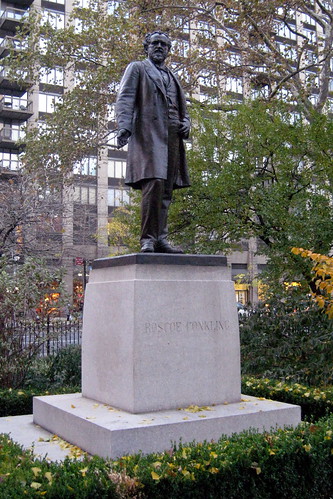 It's a statue of Roscoe Conkling (1829–1888), the most powerful figure in New York State politics in 1860s–1880s period. Here's a better look:
 Nice facial hair, keeping with the American-statesman archetype of the post–Civil War period. Conkling was the leader of the "Stalwart" faction of the Republican party in those years, opposing the "Half-Breeds," led by your homie and mine, "the Plumed Knight" James G. Blaine. And what a battle it was: Conkling & Co. were more in favor of the machine-style patronage politics that we all know and hate, while the Half-Breeds made halfhearted stabs at civil-service reform. On the other hand, Conkling's team was considered more "radical," in that they favored full equality for African-Americans (well, male African-Americans, at least) and harsher punishment for the defeated South. The Democrats didn't matter much at the time, having backed the wrong horse in the war.
Conkling did it all: mayor of Utica, member of the House of Representatives, enthusiastic backer of Ulysses S. Grant, major deal-making U.S. Senator, dark horse candidate for President in 1876 (he ended up throwing his support behind eventual winner and even darker horse Rutherford B. Hayes, a Half-Breed who was a compromise candidate over the hated Blaine). Conkling was even nominated for the Supreme Court and confirmed, yet declined to take his seat, which makes me wonder why anyone would go through all that trouble. Plus, he helped to write the 14th Amendment to the Constitution, which anti-immigrant wackos are currently talking about repealing, so if they really want to make that happen, they'll have to go through Conkling's ghost first.
Basically, if you wanted to get anywhere in the Republican party in the 1870s and '80s, you had to genuflect at the feet of Mr. Conkling, and his legacy among the political trivia of that era in our country's history is broad. To placate the the Stalwarts, the party made Hayes take as his running mate a nobody upstate New York congressman named William Wheeler; four years later, a similar maneuver gave the VP slot to Conkling's protégé, Chester A. Arthur, "the Mutton-Chop King." In fact, Conkling and Arthur were so tight, when James Garfield was murdered (by Charles Guiteau, easily the most interesting assassin in American history, though don't get me started), some believed it was a plot engineered by Conkling to put his boy in the big chair. It wasn't, and when Arthur turned out to be a somewhat competent chief exec dedicated to civil-service reform, the two had a serious falling out and never made peace.
I'm rambling here, hopefully interestingly so, but the point is this: That statue of Conkling directly overlooks the interminable Shake Shack line, and I have to wonder if this bothers anyone. Despite all he did for our state's history (good or ill), his most prominent legacy now is that thousands of people stare at him while grumbling about tourists and lead-footed burger flippers. Is there a Conkling Historical Society somewhere that has protested this, a monumental (pun!) trivialization of his life of distinction? Did Danny Meyer consider this before he built the Shack at this exact place? And, to get a little supernatural for a moment, what if the soul of Conkling is trapped in the statue, and he is forever fated to watch the slothlike movement of yuppies and hipsters awaiting greasy slabs of meat? Is this his private hell for fattening his own and his buddies' coffers at the expense of the public good? Stop chewing that Burger Joint burger, then discuss.
August 6, 2010
Shake Shack vs. Roscoe Conkling

June 30, 2009
Hail to the hirsute
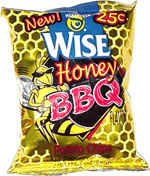
While availing myself of some ridiculously delicious Wise Honey BBQ potato chips from the vending machine at the day job, I noticed something interesting… Sorry for the crappy photos and inaccurate date, but I am a legendarily bad photographer. Still, my point is made: The fictional sample President pictured on the venue machine looks like no President that had ever occupied the White House. He has shoulder-length hair and a walrus mustache. Apparently, in Vending Machine Land, General Custer survived Little Bighorn and was elected chief executive immediately afterward.
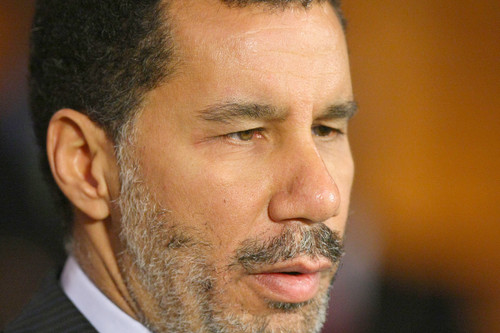
The choice of this picture really puzzles me, since we haven't had a President with facial hair in almost 100 years. Apparently, modern Americans think if you haven't shaved, you have something to hide. There was a bit of a to-do several years ago, in fact, when Jon Corzine was first running for governor of New Jersey and advisers told him to lose his beard; he refused, but won anyway. (And of course, we here in New York now have our own bearded governor, for all the good he's doing us. New Mexico's joined the club too, though I suspect Richardson stopped giving a shit once he flamed out in the presidential election.)
Discounting the sweet sideburns on the face of President Martin Van Buren (1837–1841), our first facially haired President was Abraham Lincoln (1861–1865). Nine of the next eleven chief executives were hirsute (counting Grover Cleveland twice, as most historians do). Best of the lot was definitely Rutherford B. Hayes (1877–1881):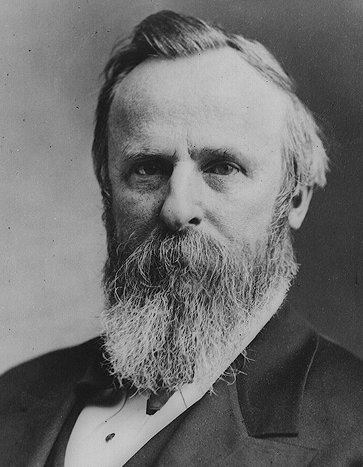 That last to be mustachioed was William Howard Taft (1909–1913). Personally, I think facial-hair hatred has always been baseline for American culture; the late 1800s were an anomaly, brought about by the Civil War. For whatever reason—maybe just that both Lincoln and Lee wore whiskers—facial hair became fashionable during the conflict, and it was nearly mandatory that postwar politicians appropriate the look (if not an actual record) of Civil War service. The aesthetic persisted long enough to carry over into the early 20th century, but was dead by the First World War. Still, check out this sweet look on 1916 Republican nominee Charles Evans Hughes:
 That last hirsute major-party nominee was New York's own Thomas Dewey, Republican candidate in both 1944 and '48:
 A famous quip from the '44 campaign was from Alice Roosevelt Longworth (TR's eldest), who compared the Republican to "the little man on the wedding cake." Humiliation like that went a long way toward both of Dewey's losses. The tide was turning against facial hair, never to return, despite what the vending-machine industry says.
Bonus: Check out the great T-shirt BQT doorgirl Sherry got me for my birthday last year (the back gives an honorable mention to Martin VB):