Showing posts with label pro wrestling. Show all posts

May 20, 2011

"Macho Man" Randy Savage, 1952–2011


Say it with me: "From Sarasota, Florida, weighing 245 pounds…'Macho Man' Randy Savage!"

Somehow, this one actually bothers me. I don't usually get upset when celebrities die, because I don't usually know them personally, but occasionally, I feel a fan's true remorse. It happened when Rodney Dangerfield died, I recall. And now, "Macho Man" Randy Savage, one of the top names in pro wrestling back when I was a little pro-wrestling fanatic and, in my opinion, one of the most talented performers in the history of the medium. He died in a car accident this morning at 58.

In brief: Randy Savage (né Poffo, so yes, this guy was his brother) was the son of a wrestler and promoter, jumping into local wrestling in the Memphis region after his initial pro-baseball plan fell through. In the early '80s, as Vince McMahon's World Wrestling Federation expanded the "sport" into entertainment's A-list, Savage was brought in as an ideal villain. His talent was impossible to deny: Speed, skill, flash, and charisma, the guy had every tool in the wrestler's arsenal. He brought along his real-life girlfriend, the anodyne but beautiful Elizabeth Hulette, to be his manager/valet, "Miss Elizabeth," and the two worked a mildly abusive-boyfriend angle that attracted insane heat (i.e., the good kind of fan hatred). After a couple years, his appeal impossible to deny, Savage turned face (became a good guy) and became one of medium's most beloved good guys. He stayed on top for a decade, flipping back and forth between good and evil, but always in the plausible way that separates good wrestling from eye-rolling garbage.

My favorite Macho Man match: WrestleMania VII, 1991, a retirement match versus the Ultimate Warrior:


The adjective most often ascribed to Savage was intense. He perpetually seemed to be on the knife's edge, from his ominously whispered promo interviews to the furiously controlled way he carried himself in the ring. The reason I love this match is because it sets the stakes so high—the loser would have to quit pro wrestling, after all—and both performers play it to its hilt. (It's also my favorite Ultimate Warrior match, though that isn't saying so much.)

And to answer your question, wrestling nerds, yes, I do prefer this bout to Savage's epic showdown with Ricky "The Dragon" Steamboat at WrestleMania III. Though that match deserves the epic, for sure:


Savage was a great villain (as seen above), a great hero, a great athlete and a great storyteller. He might have been the perfect 1980s wrestler: a colorful and exciting figure who helped bring the medium to its worldwide success, yet still a consummate physical performer who maintained the integrity of its athletic tradition (when it came to actual wrestling, he could work circles around Hulk Hogan, and more than held his own against Ric Flair). He was a world-class entertainer, someone with bona fide star power, which is very sadly in too short a supply these days. One last time:


September 11, 2010

Ring of Honor: Definitely pro, definitely wrestling

For several years during my childhood, I was a huge pro wrestling fan. And my dad—who was willing to do anything for his kids—was a good enough sport to take me to more than a few live WWF events, including WrestleManias III and V. I clearly recall, waiting online to get into the Pontiac Silverdome for WMIII, my father looking at the crowd and wondering out loud how many of the people thought wrestling was real. Thankfully, nobody kicked his ass.

In hindsight, the answer was "some." I'd guess it was about half the children (and there were lots of children there), and a small percentage of the adults, believed that Kamala the Ugandan Headhunter was actually a cannibal from the jungles of Africa. But I think most of the grown-ups knew the score. As I often say, if you complain that wrestling is fake, you're missing the point: It's supposed to be predetermined, and the punches are only partly pulled. Nobody complains that West Side Story is fake.

Tonight I went to a live wrestling card for the first time in more than 20 years: I was at the Grand Ballroom at Manhattan Center (same complex as Hammerstein Ballroom) to see Ring of Honor's "Glory by Honor IX." Eight matches of some serious, serious professional wrestling. Ring of Honor prides itself on being a higher caliber than the current WWE product—much less emphasis on the soap operatics, much more appreciation of the physicality of the show. I saw suplexes, I saw powerbombs, I saw a whole lot of enzuigiris. Predetermined or no, these guys are serious athletes, and the fans are serious about their appreciation of it.

Most of the matches followed a formula: two (or four) roid-sculpted bantamweight men expending frightening amounts of energy, trading punches, kicks, and disturbingly punishing-looking holds and throws. (The closest thing to a "hardcore" match was a "double chain" contest—two guys vs. two guys, each one chained to a guy on the other team. It was brutal and bloody, but they used the gimmick to tell a nice story.) One match—labeled "Best of the Best"—pitted Austin Aries against "the Fallen Angel" Christopher Daniels, and ended with a ridiculously amazing move that I can only make a pathetic attempt to describe: Basically, Daniels dropped Aries face first upside down from the top turnbuckle, three quarters of the way across the ring. Incredible.

As for the crowd, hoo-boy. Other than the fact that I was sitting next to the single biggest drunk asshole in the room (he seemed to find a lot of humor in shouting "I love HIV"), these people were true connoisseurs. They sat down to watch the action, they clapped after every impressive spot, and—lest you think they were refugees from the Bolshoi Theatre—they chanted in reaction to nearly everything ("Fuck him up!" was common; "Future jobber!" was funny). They also threw streamers into the ring at the beginning of every match. When is some cultural anthropologist going to write a dissertation about it? (Wait, someone did.)

If my dad asked how many of the people there thought it was "real," I would have to say zero. There were no kids there, and with the advent of the Internet, pro wrestling pretty much gave up on "kayfabe"—the code that dictates you never, ever admit that the characters are constructed, the outcomes scripted. Besides, as I say, if you think wrestling is fake, you're missing the point. And the people at the show tonight clearly were getting the point.

If you care about results, this guy was quick with the recap. Otherwise, I leave you with this: a three-and-a-half-year-old match between two of the superstars of the show, Austin Aries and Eddie Edwards. Enjoy:


December 7, 2008

Allow me to recommend…

One of the advantages of being in my position (you know, trivia king of New York City), is that I occasionally get the opportunity to see movies before the general public is exposed to them, either via screenings or screeners (industry lingo for advance DVDs sent to critics). For example, I saw The Dark Knight weeks before it exploded messily all over the pop-cultural landscape. Yes, I am blessed.

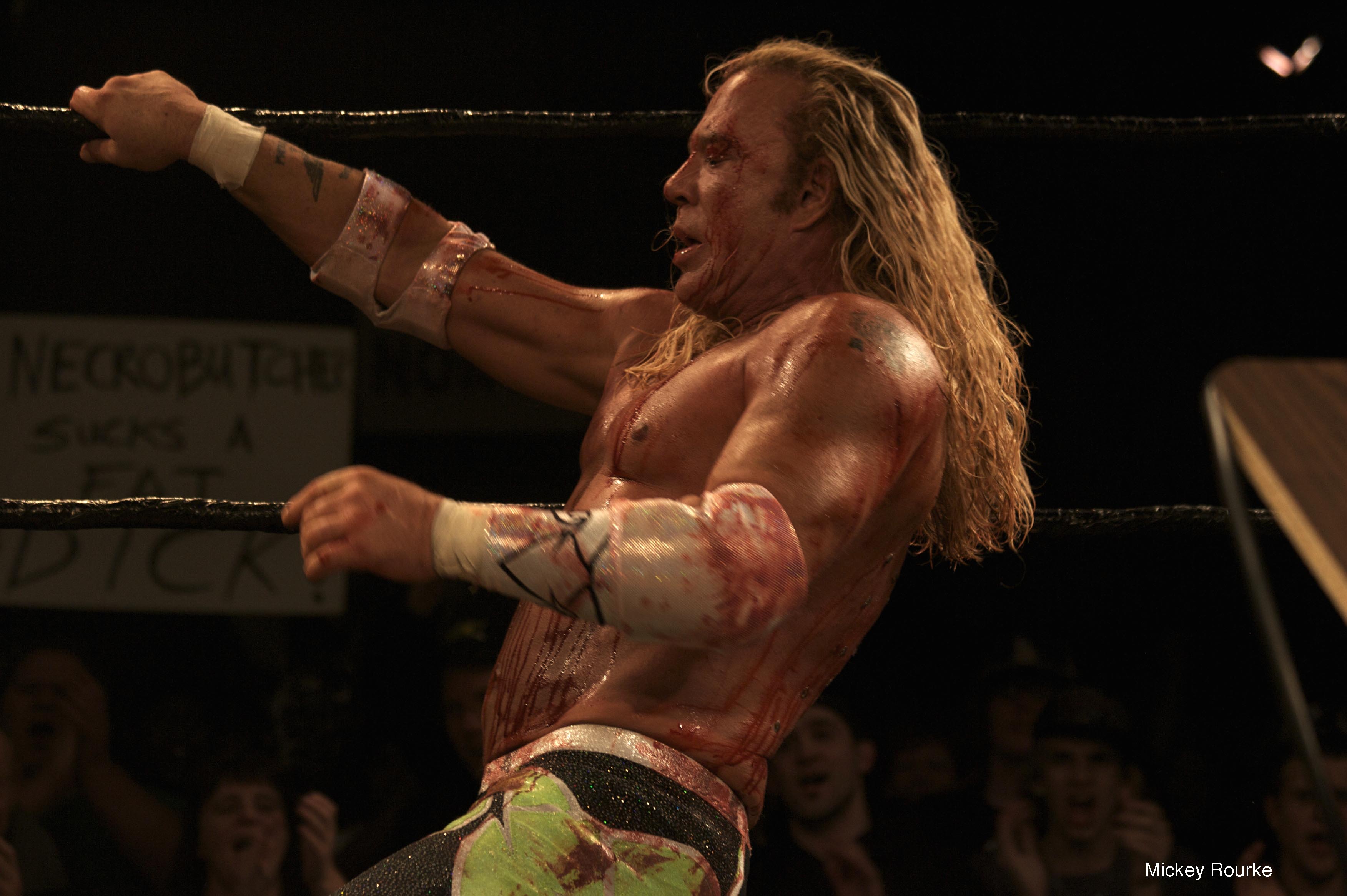
So I got just this type of lucky the other day, when a friend passed along a screener of the forthcoming film The Wrestler. Winner of the Golden Lion at the Venice Film Festival (trust me, that's good), it's an incredibly sad and well-done movie starring Mickey Rourke (above) as Randy "The Ram" Robinson, a (fictional) pro-wrestling superstar of the 1980s who finds himself scraping rock bottom in the '00s. Tons of positive hype; I know two film critics who say it's among the best films of the year. Go see it.

But regular BQTers might recall that I have a bit of a fascination with the art of professional wrestling, and occasionally dig out the odd wrestling question (occasionally—I'm not that far gone). And it occured to me while watching this film that for someone not well versed in the wrestling business, some of the lingo might be hard to follow. So as a public service, behold, the BQT's official glossary to professional wrestling terminology:

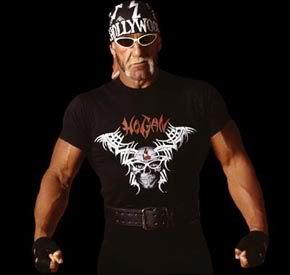
face—A "good guy" in wrestling (short for "babyface"; in the U.K. they're called "blue-eyes"). Villains are known as heels. As you're no doubt aware, a staple of the wrestling artifice is that it usually pits heroes against villains, and behind the scenes, there's a definite effort to delineate one from the other (a wrestler who is particularly Method in his performance will refuse to even travel with colleagues from the opposite side of the divide). It is common for a wrestler to switch allegiances—to "turn heel" or "turn face"—in order to freshen his character or inspire a new storyline; very few successful wrestlers stick to only one side throughout their career. Even Hulk Hogan—who was the mainstream epitome of the pro-wrestling hero in the 1980s:… turned heel in the '90s:

job—To lose. A perennial loser is a jobber (usually no-name guys who aren't even expected to be competitive). Pro wrestling, of course, is not a competitive sport, and match outcomes are determined beforehand, so there is generally little shame in losing. When you're starting out, you pay your dues to more established performers by jobbing to them; likewise, a wrestler whose best days are behind him is expected to job to up-and-coming stars, to put them over.

gas—Steroids. A wrestler on the gas is using steroids. It is not uncommon—wrestling is a difficult profession, and wrestlers are expected to put their body through extreme punishment on a near nightly basis, and look like Greek gods while doing it. Steroids help, both in building muscle mass and speeding recover time. In the early 1990s, there was a major crackdown on rampant drug abuse in the pro-wrestling business, nearly shutting down the World Wrestling Federation (now World Wresling Entertainment), then as now the dominant promotion in the business.

blade—To purposely cut oneself in order to add blood (or juice) to a wrestling match. Very dangerous, but very common, even in the era of AIDS. A great moment in The Wrestler shows, in detail, Mickey Rourke's character breaking off a razor blade and hiding it in his wrist tape, to use on his forehead during the match. This is some rough shit.

kayfabe—The code of pro wrestling, its own omerta. To keep kayfabe is to pretend—to fans, journalists and all other outsiders—that wrestling is indeed "real": the performers are their characters, the rivalries are genuine, the match outcomes are not predetermined. Kayfabe has broken down greatly in the past ten or fifteen years, partly due to the rise of the Internet (it's harder to keep secrets) and partly because the WWE has looked to become more mainstream and less secretive (hence the label "sports entertainment"). I'm not sure where this word comes from, but I think I read that it grew out of some old carny lingo thing.

fake—A pretty easy label for pro wrestling, which misses the point. Yeah, it's "fake." So is theater, so are TV shows. William Shatner didn't really captain a starship either, and the guy playing Hamlet is still alive after Shakespeare in the Park closes.

BTW, the Super Mega Ultra Hard Question of the Week will be back next weekend. See you tomorrow night at Crash Mansion…